
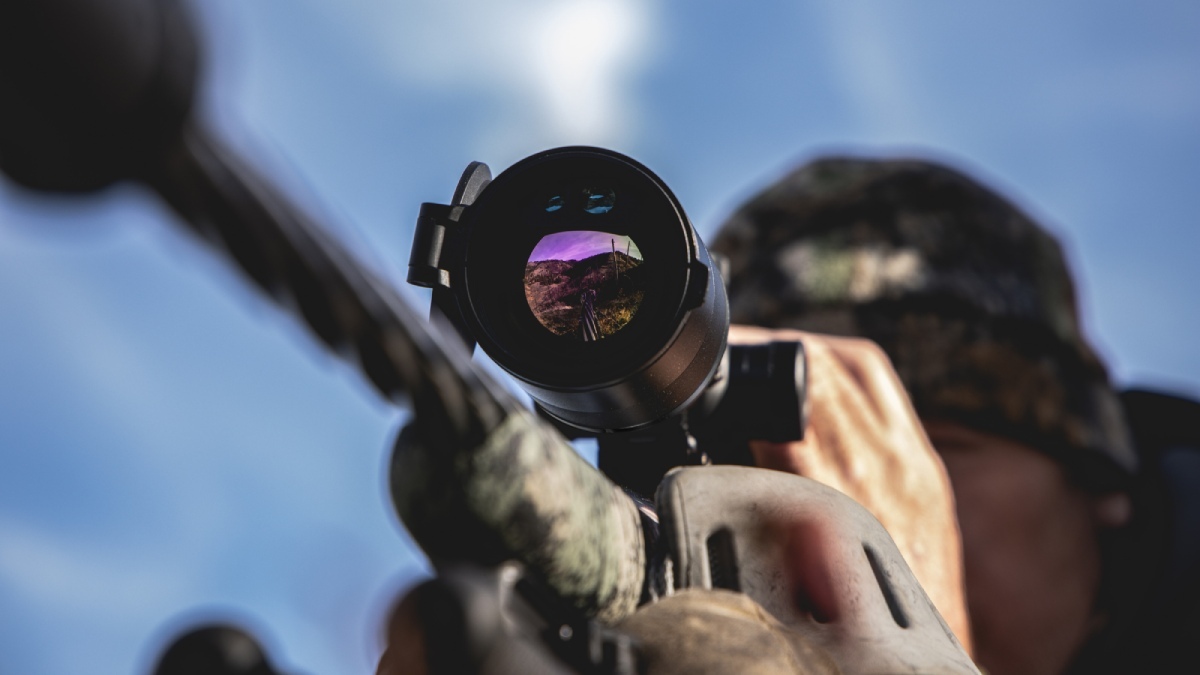
Thermal scope range isn’t just about “how far it sees.” It’s about what you can actually do at that distance.
There are three performance levels that matter in the field:
- Detection – You can tell something is there.
- Recognition – You can tell what type of animal it is.
- Identification – You can confirm exactly what it is and make a confident shot decision.
Those distances are very different.
Understanding the difference is what separates marketing numbers from real-world performance.
Detection Range: Seeing Heat
Detection is the furthest distance a thermal scope can display a heat signature.
At this range:
- You’ll see a bright shape.
- You will not see detail.
- You cannot confirm species.
Even entry-level thermals like the Ocelot 256 Thermal Imaging Scope can detect large animals several hundred yards away.
Detection range is influenced by:
- Sensor resolution
- Lens size
- Environmental temperature contrast
- Humidity and atmospheric conditions
Detection is useful for scanning wide fields — but it does not mean you can take a shot.
Recognition Range: Knowing What It Is
Recognition means you can distinguish the type of animal.
Examples:
- Coyote vs deer
- Hog vs calf
- Human vs livestock
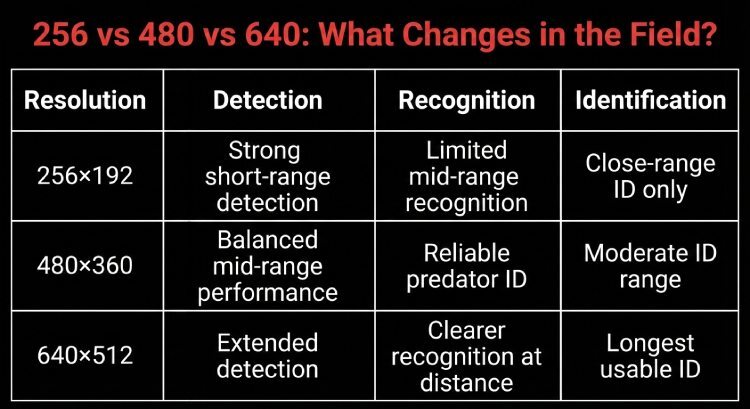
This is where resolution begins to matter significantly.
A 480 sensor improves shape clarity and edge definition. A 640 sensor like the Pantera eX 640 provides noticeably stronger recognition at longer distances.
Recognition is where most serious hunters want to operate.
Identification Range: Confirming Before You Shoot
Identification is confirmation.
You can:
- See body orientation
- Distinguish smaller features
- Confirm species with confidence
Identification range is always much shorter than detection range.
Higher resolution sensors extend usable identification distance — especially when combined with quality glass and a stable display.
This is where 640 systems separate themselves in open-field or longer-range scenarios.
The real difference is how usable digital zoom becomes.
Higher resolution = more native detail = less image breakdown when zooming.
What Affects Thermal Range in Real Conditions?
1. Humidity
Water vapor absorbs infrared energy. High humidity reduces performance.
2. Temperature Contrast
Cold nights with warm targets produce better image separation.
3. Terrain & Obstructions
Brush, tall grass, and uneven terrain block heat signatures.
4. Lens Size
Larger objective lenses gather more infrared energy and extend range.
Thermal performance is a system — not just a resolution number.
Practical Scenarios
Dense woods under 150 yards:
256 or 480 is often sufficient.
Mixed terrain predator hunting:
480 offers strong balance.
Open fields or longer ranges:
640 provides extended recognition and identification confidence.
Bottom Line
Detection range gets attention.
Identification range wins hunts.
Choosing the right thermal scope depends on how far you realistically shoot — not just how far you want to detect something glowing on screen.
FAQ Section
How far can a 640 thermal scope see?
Detection can extend beyond 1,000 yards depending on conditions, but identification distance is significantly shorter and depends on target size and environment.
Is 256 thermal enough for hog hunting?
Yes for closer-range setups and wooded areas. For open terrain and longer shots, 480 or 640 provides more usable detail.
What reduces thermal performance the most?
Humidity, poor temperature contrast, and environmental obstructions reduce effective range.